
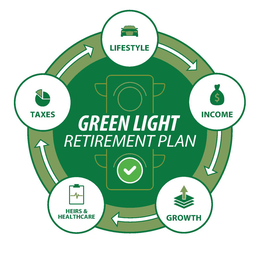
A retirement planning firm filed a trademark application for a colorful, information-rich circular design mark featuring the words GREEN LIGHT RETIREMENT PLAN at its center, along with icons representing taxes, income, lifestyle, growth, and healthcare. The Trademark Trial and Appeal Board affirmed the examining attorney's refusal to register it. The decision is In re Family Focus Retirement Group, LLC, Serial No. 98499819 (TTAB Apr. 10, 2026).
The Conflicting Marks
The USPTO refused the application based on three existing registrations, all owned by the same entity, covering investment management and investment advisory services: the standard-character mark GREENLIGHT, and two composite word-and-design marks featuring the word GREENLIGHT with stylized elements and one also having the term CAPITAL, INC.
The Board focused its analysis on the composite GREENLIGHT CAPITAL, INC. mark registered for "investment advisory and investment management services," because those services were identical in part to the applicant's identified services of "financial planning and investment advisory services."


Services: Identical, So the Bar Is Lower
The applicant did not contest the similarity of services, and the Board had little trouble finding that the second DuPont factor strongly favored a likelihood of confusion. "Investment advisory services" appeared in both the cited registration and the application. When services are identical and unrestricted as to trade channels, the Board presumes they travel in the same channels to the same consumers.
This is important because when services are identical, the degree of similarity between the marks required to support a confusion finding is lower than it would be if the services were merely related.
Third-Party Use: Not Enough to Weaken the Cited Mark
The applicant submitted screenshots of 22 websites showing third-party use of "Green Light" or "Greenlight" formative marks in various financial contexts, arguing that the word GREENLIGHT was commercially weak and therefore entitled to a narrow scope of protection.
The Board worked through each website methodically. After filtering out duplicates, websites showing use for clearly unrelated services (auto loans, mortgage origination, insurance premium financing, credit repair, nonprofit work), and one showing only historical use of a mark that had since been acquired and discontinued, the Board counted at most nine third-party uses relevant to investment advisory services.
That number mattered because the Federal Circuit has held that "voluminous," "extensive," or "considerable" third-party use evidence can be "powerful on its face" even without proof of the duration and exposure of each use. The leading cases involve 26 third-party uses for restaurant services (Juice Generation) and 14 notable examples for clothing (Jack Wolfskin). Nine uses in a large U.S. market for investment advisory services fell short of that threshold. The Board found the sixth DuPont factor neutral, and accorded the cited mark its normal scope of protection as an inherently distinctive mark.
The Marks Themselves: Green Light Dominates
The applicant's mark was visually complex: a circular design with five labeled segments, icons for each planning category, and the words GREEN LIGHT RETIREMENT PLAN at the center over a traffic light graphic. The applicant argued that the design elements and the surrounding descriptive wording created a "wholly different commercial impression" from the single word GREENLIGHT in the cited marks.
The Board disagreed.
In a composite mark containing both words and design, words generally receive greater weight in a likelihood of confusion analysis, because they are more likely to be remembered and used by consumers to identify and request the services. In this mark, the words GREEN LIGHT were the largest literal element, centrally placed, and the only non-disclaimed wording. All of the surrounding descriptive terms (RETIREMENT PLAN, TAXES, LIFESTYLE, INCOME, GROWTH, HEIRS & HEALTHCARE) had been disclaimed, meaning the applicant itself acknowledged they lacked independent source-identifying significance.
The Board also noted that the design elements reinforced rather than distinguished the mark. A green traffic light graphic sitting behind the words GREEN LIGHT does not create a separate commercial impression; it underscores the same one.
The applicant's own specimen drove the point home. On the applicant's website, the service was referred to simply as "The Green Light Retirement Plan," with surrounding text encouraging consumers to associate the brand with receiving a "green light" that they are "good to go." The Board found it likely, indeed probably inevitable, that consumers would shorten the mark to "Green Light" when referring to or requesting the services.
With GREEN LIGHT as the dominant element in the applicant's mark and GREENLIGHT as the dominant element in the cited mark, the Board found the marks similar in appearance, nearly identical in sound (once consumers predictably shortened the applicant's mark), and conveying the same general meaning: financial readiness, permission to proceed.
If you have received a likelihood of confusion refusal, or you want to assess your options before filing, Five Dogs Law offers a free consultation. Book a time here.
.svg)